
Get Your Quote for Water Heater Repair
Tell us about your Water Heater Repair in New York and we will come back with a price before any work starts.
Tell us about your Water Heater Repair in New York and we will come back with a price before any work starts.
A water heater that fails without warning can leave a household with cold showers and a flooded basement floor by morning. Water Heater Repair Brooklyn catches the failure before it turns into an emergency.
Most water heaters do not die quietly. They rattle, drip, run lukewarm, or take twice as long to recover between showers for weeks before the tank finally gives out completely for homes across Brooklyn. Ignoring those early signals almost always costs more than acting on them, whether that cost shows up as a flooded utility room, a spiked gas bill, or a Saturday morning with no hot water for the whole house. Our team treats every Water Heater Repair Brooklyn call as a chance to catch the problem while it is still a repair, not a replacement.
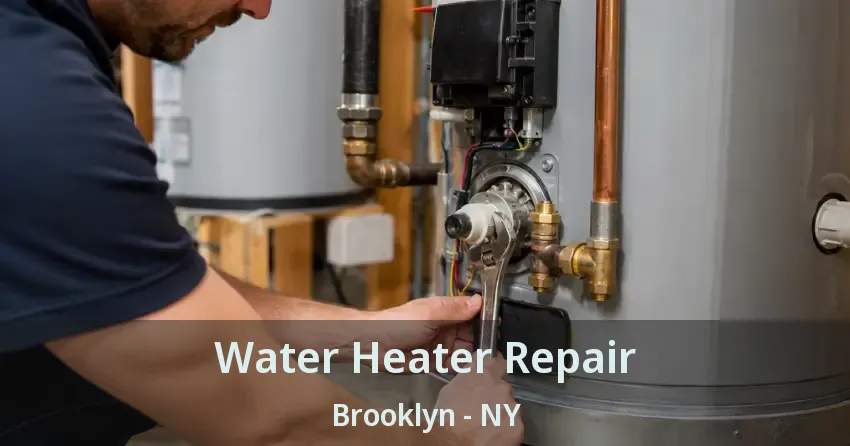
Most tanks rarely fail without giving some notice first. Lukewarm water, a pilot light that will not stay lit, or a puddle forming near the base of the tank are the three most common reasons homeowners across Brooklyn call for service. Any one of these on its own is worth a call, and more than one appearing together usually means the unit needs attention within days, not weeks.
Homeowners who notice two or more of these at once should treat it as a priority call for Water Heater Repair Brooklyn rather than something to schedule around. A tank that is actively leaking from the bottom is the one exception on this list that almost always points toward replacement rather than repair, since internal corrosion cannot be patched.
Water heater repair typically costs between $150 and $600 depending on the specific component involved and whether the unit is gas or electric. A thermocouple or heating element replacement generally sits toward the lower end, while a gas control valve replacement or a repair on a less common model can run higher. Contact Gas Service New York for a quote specific to your unit.
A pilot light that will not stay lit is most often caused by a failing thermocouple, the safety sensor that confirms the flame is burning before allowing gas to flow. A dirty pilot orifice or a failing gas control valve can cause the same symptom, so a technician tests the thermocouple's millivolt output directly rather than guessing at the cause.
A unit under 6 years old with a failed thermocouple or heating element is almost always worth repairing, since the tank has years of useful life left and the part costs a fraction of replacement. A unit past 10 years that is leaking from the tank body itself, rather than a fitting or valve, signals internal corrosion that repair cannot fix.
Most straightforward repairs are completed in a single visit lasting 1 to 3 hours, since common parts like thermocouples, heating elements, and thermostats are typically carried on the truck. A repair requiring a special-order part for an older or less common model can take a day or two longer.
An electric water heater that stops producing hot water usually traces back to a tripped high-limit switch, a failed heating element, or a bad thermostat. Since electric units use two heating elements each controlled by its own thermostat, a failure in either pair can leave a household with partial or no hot water depending on which one fails first.
Not always. A leak from a fitting, valve, or the pressure relief tube is often repairable, while a leak coming from the tank body itself means internal corrosion has already breached the steel lining and repair will not hold. A technician can confirm the source of the leak during an inspection.
Flushing sediment from the tank once a year meaningfully reduces the mechanical stress that leads to repeat failures, especially in areas with harder water. Households that skip this maintenance tend to need their first major repair years earlier than those on a regular flush schedule.
Yes, same-week appointments are realistic for most straightforward repairs that do not require a special-order part. Gas Service New York prioritizes water heater calls since a household without reliable hot water is a genuine daily disruption.
A failing water heater does not stay a small problem for long. A pilot light issue left unaddressed can mean days without hot water for a household in Brooklyn, while a slow leak at a fitting or valve can quietly damage flooring, drywall, and stored items in a basement utility room before anyone notices. Water damage remediation routinely costs several times more than the repair that would have prevented it.
Sediment buildup compounds the same way for tanks across Brooklyn. As sediment hardens across the bottom of a tank, it insulates the burner from the water above it, forcing the unit to run longer and burn more gas or electricity to reach the same temperature. That inefficiency shows up as a gradually climbing utility bill months before the unit actually fails, which is why homeowners often assume rising costs are unrelated to the water heater until a technician flushes the tank and the bill drops back down.
A gas water heater's pilot light usually goes out because of a failing thermocouple, a safety sensor that confirms the pilot flame is actually burning before it allows gas to flow to the main burner. Our technicians see this on units of every age across Brooklyn, though it becomes more common as a unit passes the 8-year mark. When the thermocouple weakens or corrodes, it can no longer send a reliable signal, and the gas control valve shuts off gas to protect the household from an unlit flame filling the room with fuel.
Drafts, a dirty pilot orifice, or a failing gas control valve can cause the same symptom in homes throughout Brooklyn, which is why relighting the pilot repeatedly without diagnosing the actual cause rarely solves anything for long. Our technicians test the thermocouple's millivolt output directly rather than guessing, since a weak thermocouple signal is the single most common reason a pilot light will not hold across older units.
An electric water heater that stops producing hot water almost always traces back to one of three things: a tripped high-limit switch, a failed heating element, or a bad thermostat. Electric units in homes across Brooklyn use two heating elements, an upper and a lower, each controlled by its own thermostat, so a failure in either pair can leave a household with partial or no hot water depending on which one goes first.
A tripped breaker is the easiest fix and worth checking before calling anyone, since a simple reset sometimes solves the problem outright for households in Brooklyn. If the breaker trips again shortly after being reset, that points toward a short in a heating element rather than a one-time electrical hiccup, and continuing to reset the breaker without diagnosing the short risks damaging the wiring further.
Our team repairs tank and tankless water heaters for households across Brooklyn that want parts sourced correctly the first time rather than a generic substitute that voids the manufacturer warranty. Our trucks carry compatible thermocouples, heating elements, and gas valves for most model years without needing a special order.
Matching the exact part to the unit matters more than homeowners often expect, since control boards and valve assemblies vary between model generations even within the same product line. Our technicians confirm the model and serial number before recommending a part, which avoids the repeat visit that comes from installing a close-but-not-quite-right component. This attention to detail matters especially on gas units, where an incorrect valve assembly can create a genuine safety issue rather than just a poor fit.
Households across Brooklyn with an aging unit sometimes assume replacement parts are hard to find once a model is discontinued, but most common components stay in production for years after a specific tank model is retired. Our team checks part availability during the initial diagnostic call whenever possible, so homeowners know upfront whether a repair can be completed on the first visit or whether a short wait for a specific component is realistic.
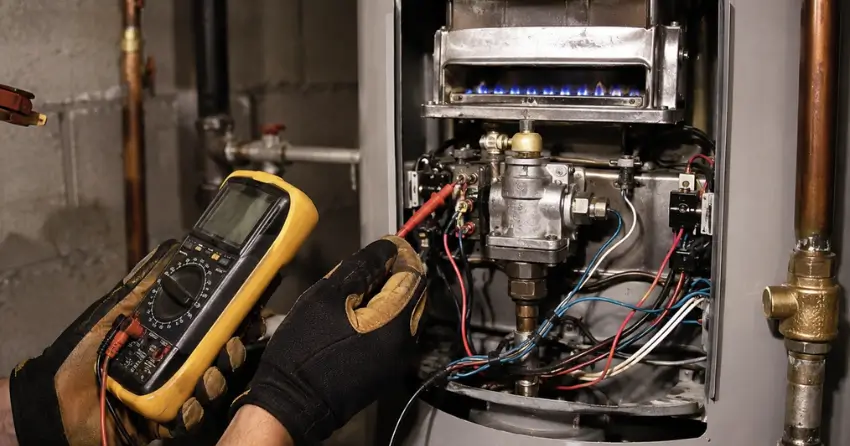
A proper water heater repair visit for homes across Brooklyn starts with a full diagnostic rather than jumping straight to the part the homeowner suspects is at fault. Our technicians check gas pressure and venting on gas units, test element resistance and thermostat function on electric units, and inspect the tank itself for any sign of corrosion that would make repair pointless.
Once the actual cause is confirmed, most straightforward repairs across Brooklyn are completed in a single visit, since common parts like thermocouples, elements, and thermostats are carried on the truck. A final step every visit includes is a functional test: running hot water at full temperature for several minutes to confirm the fix holds under real use rather than just on the bench.
Homeowners waiting on a repair visit can safely turn down the thermostat setting on an electric unit as a temporary measure. Attempting to open the tank or replace a gas valve without training is not recommended, since gas control valve replacement carries real safety risk if installed incorrectly.
A standard tank water heater generally lasts 8 to 12 years, and that age is the single biggest factor for homeowners in Brooklyn deciding whether a repair genuinely makes sense. A unit under 6 years old with a failed thermocouple or heating element is almost always worth repairing, since the tank itself still has years of useful life left and the part costs a fraction of full replacement.
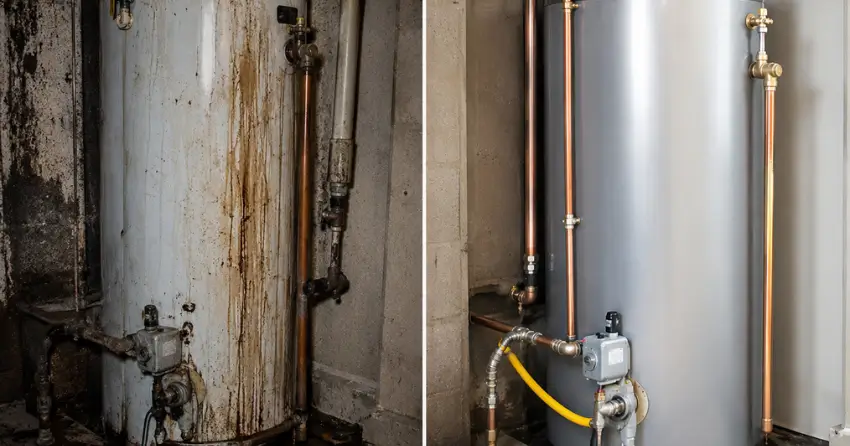
A unit past 10 years that is leaking from the tank body, rather than from a fitting or valve, is the clearest signal that repair will not hold. Internal corrosion that has progressed to a visible leak means the tank wall has already failed, and no amount of sealant or patching addresses corrosion happening from the inside out. Our team walks homeowners across Brooklyn through this decision honestly rather than defaulting to whichever option costs more.
A tankless unit installed in Brooklyn uses a different repair approach than a standard tank because the failure points are almost entirely electronic rather than mechanical. Error codes on the tankless display point technicians directly to the failing component, whether that is a flow sensor, an igniter, or a heat exchanger thermistor, which speeds up diagnosis considerably compared to a tank system with no built-in diagnostics.
Our technicians read the error history stored on the control board before starting any physical inspection, since a unit that has thrown the same code repeatedly points toward a different root cause than one showing a single new fault. This step alone often narrows the repair down to one or two likely components before a single panel is removed, which keeps labour time down for households across Brooklyn paying by the visit rather than the hour.
An anode rod is a sacrificial metal rod designed to corrode before the tank's steel lining does, and it typically needs replacement every 3 to 5 years depending on local water hardness in Brooklyn. Skipping anode rod replacement is one of the quietest ways a tank's lifespan gets cut short, since the corrosion protection simply stops working once the rod is fully consumed. A heating element failure is usually more obvious, since the household loses hot water on one side of the tank's capacity almost immediately once the element burns out.
Replacing either component is a straightforward job for a technician who already has the tank drained and the top panel open. Our team often checks both at the same time rather than treating them as two separate service calls whenever a homeowner reports reduced hot water volume.
A thermocouple is a low-cost, quick repair in most cases for units across Brooklyn, while a gas control valve replacement takes longer and costs more since the valve regulates both pilot and main burner gas flow. Confirming which component has actually failed before ordering parts avoids paying for a valve replacement when the real issue was a simpler thermocouple fix.
Testing the thermocouple's millivolt output takes only a few minutes with the right meter, and that single test is usually enough to rule the part in or out before any parts are ordered. Skipping that test and replacing the gas control valve on a hunch is how homeowners across Brooklyn sometimes end up paying extra for a part that was never actually the problem in the first place.
A correctly diagnosed and properly installed repair should hold for the remaining useful life of the tank, which for a unit under 10 years old typically means several more years of reliable service before another component needs attention. The key word is correctly diagnosed: a repair aimed at the wrong component often appears to work briefly before the original symptom returns.
Regular maintenance meaningfully extends how long a repair holds. Flushing sediment from the tank annually and checking the anode rod every few years reduces the mechanical stress that leads to repeat failures, which is why households across Brooklyn that stay on a maintenance schedule tend to see fewer emergency calls between major repairs.
A tank that receives no maintenance at all tends to show sediment-related noise and reduced hot water capacity years earlier than one on a regular flush schedule. Homeowners across Brooklyn who book a repair are often surprised how much longer the unit performs afterward once the underlying sediment or corrosion issue is addressed alongside the original complaint, rather than just patching the single symptom that prompted the call.
Booking a repair at the first sign of trouble, rather than waiting for total failure, gives homeowners across Brooklyn far more scheduling flexibility and avoids the premium that comes with an emergency, no-hot-water call. A lukewarm tank or an intermittent pilot light is a signal worth acting on within days, not something to leave until the weekend when the whole house has no hot water at all.
Our technicians keep flexible scheduling specifically because water heater problems tend to develop gradually before failing suddenly, and catching that gradual stage is when repair actually saves money compared to replacement. A same-week appointment is realistic for most straightforward repairs that do not require a special-order part.
Households across Brooklyn who wait until the tank fails completely often end up choosing whichever provider can come fastest, rather than the one they would have chosen with more time to compare options. Booking early removes that pressure and gives homeowners the chance to ask questions about the diagnosis before committing to any repair.
Typical costs for Water Heater Repair Brooklyn in the area range from $150 to $600 depending on the specific component involved and whether the unit is gas or electric. A thermocouple or heating element replacement generally sits toward the lower end of that range, while a gas control valve replacement or a repair requiring parts sourced for an older or less common model can run higher. Contact us via contact us or call (646) 576-7805 to get a quote specific to your unit and situation before any work begins.
Every quote reflects an actual diagnostic visit rather than a guess made over the phone, since two units showing the identical symptom can have very different underlying causes and very different repair costs for homes across Brooklyn. A technician who inspects the unit in person can confirm whether the tank itself is still sound, which determines whether the job stays on the lower end of the range or points toward replacement instead.
Gas Service New York is fully licensed and insured, and every water heater repair is backed by a workmanship guarantee covering the parts and labour involved in the visit. With 15 years of hands-on experience repairing tank and tankless systems throughout Brooklyn, our technicians have worked on nearly every brand and model a residential property is likely to have installed.
We diagnose before we recommend, and we tell homeowners honestly when a repair is the right call versus when the tank's age and condition mean replacement will serve them better long term. That approach is why households across Brooklyn call Gas Service New York again the next time something needs attention, rather than searching for a new provider each time.
Every technician arrives with the common parts already stocked for the most widely used models, which is what makes single-visit completion possible on the majority of straightforward jobs rather than a repeat trip once the correct component is identified.
Early warning signs are not something that improves by waiting, and every week of delay adds wear to components that are still repairable today. Gas Service New York schedules Water Heater Repair Brooklyn appointments quickly, because a household without reliable hot water is a genuine daily disruption, not just an inconvenience.
Whether the issue is a pilot light that will not hold, a breaker that keeps tripping, or water that never quite gets hot, our team arrives ready to diagnose the actual cause across Brooklyn rather than guessing at a fix. To book an assessment, contact us or call (646) 576-7805 and our team will confirm a time that works, often within the same week depending on the nature of the repair needed.
Most water heater failures trace back to a handful of components. Here are the issues our clients call us about most often and how we fix them.
A pilot that keeps going out is almost always caused by a worn thermocouple or thermopile, the small sensors that tell the gas valve the pilot flame is active. When these parts degrade, the control system shuts off the gas supply as a safety measure even though the pilot is trying to light. We test both components and replace whichever is causing the signal failure, restoring reliable ignition in most cases during the same visit.
A complete loss of hot water usually points to a failed pilot, a faulty gas valve, a tripped thermal cutoff, or a control board that has stopped sending operating signals. Each of these causes a different symptom pattern during the diagnostic, which is why guessing at the fix rarely works. We test the full ignition and control path before recommending any replacement parts.
Consistently under-temperature hot water usually comes from a thermostat that has drifted out of calibration, heavy sediment insulating the burner surface, or a gas valve not delivering the correct fuel volume to sustain a full heating cycle. We diagnose which condition applies and correct it, whether that is recalibration, a flush, or a valve replacement.
Leaks at the inlet, outlet, or pressure relief valve discharge pipe are usually caused by corrosion at the fittings, a failing valve seat, or a connection that has loosened over years of thermal expansion. These are correctable repairs in most cases. Leaks from the tank body itself are a different situation and typically indicate the tank has failed internally.
A pressure relief valve that opens repeatedly is signaling that the unit's operating pressure or temperature is exceeding safe limits. This can happen because of thermal expansion in a closed system, a stuck-open valve seat, or a thermostat running the burner too long per cycle. We do not treat a releasing pressure relief valve as a minor issue, as it is a safety signal that requires a proper diagnosis.
A gas smell near the water heater should be taken seriously and never ignored or ventilated without also shutting off the gas supply. Common sources include a loose flex connector, a corroded fitting, or a gas valve allowing a small amount of unburned gas to escape. We inspect the full supply path from the shut-off to the burner and correct any leak points found during the visit.
Loud rumbling or banging during a heating cycle is almost always sediment forcing its way through a compressed layer on the tank floor. The sediment insulates the burner, forces longer run cycles, and accelerates thermal stress on the tank bottom. We flush sediment where flushing can still make a meaningful difference and advise on replacement when the buildup has progressed beyond what a flush can correct.
Modern gas water heaters use electronic control boards and safety sensors to manage operation and shut the unit down if an unsafe condition is detected. When these components fail, the unit may shut off unexpectedly, fail to respond to thermostat inputs, or refuse to ignite at all. We diagnose control board and sensor failures with the correct test equipment and replace only what has actually failed.
A gas water heater approaching or past the 10 to 12 year mark is entering the period when tank failure, anode depletion, and sediment accumulation all accelerate together. Continuing to repair an aging unit often costs more over two or three years than a proactive replacement. We assess the condition honestly and help homeowners decide whether repair or replacement is the better long-term investment.
Our pilot light kept going out and I had already relit it four or five times myself. The technician from Gas Service New York tested the thermocouple with a meter and found it was reading low, swapped it out, and it has held steady ever since.
I fully expected to be told I needed a whole new tank. Instead the technician explained our unit was only 4 years old and the heating element was the actual problem. Fixed in under an hour and saved us a lot of money.
Our tankless unit needed a specific control board that wasn't on the truck, so we waited two extra days for the part to arrive. Once it came in, the install was quick and everything has worked perfectly since.
I called Gas Service New York about a small puddle near the tank and the technician found a loose fitting rather than a tank issue. Quick fix and he checked the anode rod while he was there since it was close to due.
Woke up to a cold shower and called first thing in the morning. They had someone out by early afternoon, diagnosed a tripped high-limit switch and a failing element, and we had hot water again before dinner.
The technician explained exactly what was wrong with the gas control valve and gave me the price before starting any work. Gas Service New York stuck to that number even though the job took a little longer than expected.
Tell Gas Service New York what your system is doing and we will get a licensed technician to you in New York.
Call for anything urgent. For everything else, the form reaches the same team.
CALL US (646) 576-7805 EMAIL US Click to send a messageSend the details. Your information stays private.

